The 2027 IATA DGR Changes for Passengers and Crew
Butterfly Training US · November 16, 2026
The 2027 IATA DGR changes take effect on 1 January 2027, when the 68th edition of the IATA Dangerous Goods Regulations begins to apply. For passenger handling, cabin crew and security screening staff, the changes that matter most are a split in the old Table 2.3.A, a two-power-bank limit, a lower spare battery cap and a ban on power banks over 100 Wh.
This post walks through what the 68th edition changes for passengers and crew, and what front-line staff should do differently at check-in, the gate, in the cabin and at the screening point.
What Changes on 1 January 2027 for Passengers and Crew?
The 68th edition of the IATA Dangerous Goods Regulations (DGR) applies from 1 January 2027. It carries amendments from the ICAO Dangerous Goods Panel and the IATA Dangerous Goods Board, touching classification, packing, marking and the rules for what passengers and crew may carry.
IATA’s list of significant changes for the 68th edition names no change to DGR 1.5, the section that sets training validity. You can read the full list of significant changes from IATA directly.
For passenger-facing teams, two parts of the regulations matter most: Section 1.4, which sets operator duties, and Section 2.3, which lists what passengers and crew may carry.
Under 1.4.2, operators must keep their manuals current and set procedures for employees on dangerous goods that passengers and crew may carry only with the operator’s approval. A new paragraph, 1.4.3, says operators must weigh the fire risk of an item and whether crew can control a situation until a safe landing before granting that approval. 1.4.4 adds that operators must set requirements for passengers who ask for approval to carry certain dangerous goods.
What Are Tables 2.3.A, 2.3.B and 2.3.C?
Table 2.3.A, the single reference passenger handling and security teams have used for years, is now split into three tables:
• Table 2.3.A – items a passenger or crew member may carry only with the operator’s approval.
• Table 2.3.B – items that do not need approval.
• Table 2.3.C – items that were in the old Table 2.3.A but that passengers and crew may no longer carry at all.
Table 2.3.C is transitional. IATA expects to remove it in the 70th edition. Until then, gate and check-in staff who get a question about an unusual item should check which of the three tables it now falls under, rather than relying on memory of the old single table.
What Are the New Power Bank and Spare Battery Limits?
Several of the most visible 2027 IATA DGR changes affect power banks and spare lithium batteries that passengers and crew carry in the cabin.
Power bank limits
• Power banks with lithium-ion batteries over 100 Wh are forbidden for passengers and crew (2.3.1.4).
• Passengers and crew may carry no more than 2 power banks (2.3.5.8).
• An operator may allow more spare batteries than the base limit, but never more than 2 power banks.
Spare battery limits
• The spare battery limit drops from 20 to 18 (2.3.5.8).
• Battery allowances for portable electronic devices are now stated ‘per device,’ which affects how staff count multiple devices for one passenger.
Mobility aids and other devices
• Mobility aids with lithium-ion batteries get a stronger safety focus. Operators have added requirements where the installed battery exceeds 300 Wh per device (2.3.2.4).
• A new paragraph, 2.3.0.9, addresses galvanically separated batteries carried by passengers.
• Section 2.5 states that crew carriage and use of power banks for aircraft operations must be covered in the operations manual; personal use by crew still falls under 2.3.
Passenger handling staff who explain these limits at the counter can walk through examples in the HAZMAT for Passenger Handling Personnel 7.5 – DGR IATA Initial course.
What Must Check-In, Gate, Cabin and Security Staff Do?
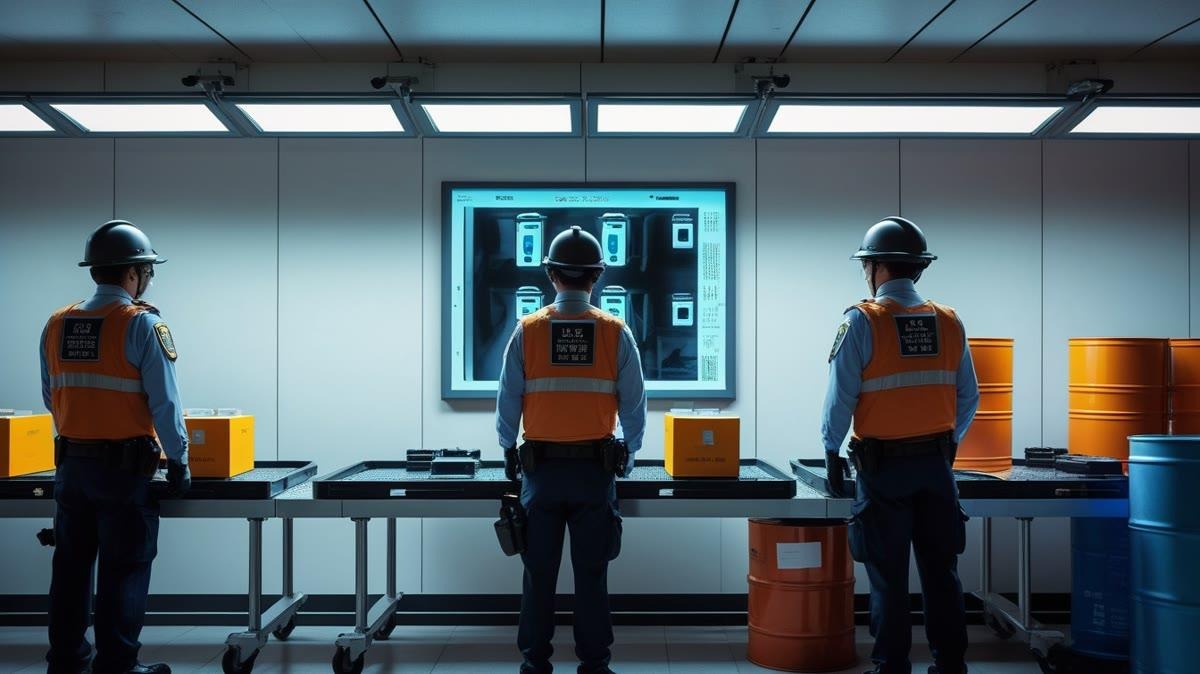
Security screening staff should know which items moved to Table 2.3.C and are no longer allowed.
Check-in and gate staff
• Confirm that a passenger is not carrying more than 2 power banks, and that none exceeds 100 Wh.
• If a passenger asks to carry an item that needs approval, follow the operator’s procedure set under 1.4.2 and 1.4.4 rather than deciding on the spot.
• For mobility aids with large installed batteries, apply the added requirements under 2.3.2.4 and route questions to the operator’s approval process.
Cabin crew
• Know that personal power bank use follows 2.3, while power banks used for aircraft operations are covered in the operations manual under 2.5.
• Watch for passengers drawing on power banks that exceed the 2-power-bank limit once already on board.
Security screening staff
• Recognize that items formerly accepted under the old Table 2.3.A may now sit in Table 2.3.C and are no longer allowed at all.
• Check State and operator variations for the route, since 2.8 lists new or changed variations for several States, including New Caledonia and Norfolk Island, and these can add route-specific limits.
Cabin crew can review these duties in the HAZMAT for Cabin Crew 7.9 – DGR IATA Initial course, and screening staff can do the same in the HAZMAT for Security Screening Personnel 7.10 – DGR IATA Initial course.
How Can Staff Prepare for the 68th Edition?

Butterfly DGR course material cover, worker in a warehouse, online course.
The 68th edition takes effect on 1 January 2027, which gives passenger-facing teams time to work the new tables and limits into daily routines before the date arrives.
Staff can review the updated tables, the power bank limit and the spare battery cap in their role-based initial course well ahead of the date, so the new figures are familiar before they come up at the counter or the screening lane. These passenger handling, cabin crew and security screening courses come from the team behind an IATA CBTA Center of Excellence.
For a full view of role-based dangerous goods courses, see the IATA dangerous goods training page.
Frequently asked questions
What is the two-power-bank limit under the 2027 IATA DGR changes?
Under 2.3.5.8, passengers and crew may carry no more than 2 power banks. An operator may allow more spare batteries than the base limit, but never more than 2 power banks.
Can a passenger carry a power bank over 100 Wh in 2027?
No. Under 2.3.1.4, power banks with lithium-ion batteries over 100 Wh are forbidden for passengers and crew.
How many spare batteries can a passenger carry after 1 January 2027?
The spare battery limit drops from 20 to 18 under 2.3.5.8. An operator may allow more than 18 spare batteries, but the 2-power-bank limit still applies.
What is Table 2.3.C and why does it matter?
Table 2.3.C lists items that were formerly in Table 2.3.A but that passengers and crew may no longer carry. It is transitional, and IATA expects to remove it in the 70th edition.
The 2027 IATA DGR changes bring new tables, lower battery limits and a ban on power banks over 100 Wh into daily contact with passengers. Front-line staff who know where to find the current figures can handle questions calmly at the counter, the gate, in the cabin and at the screening point. Role-based IATA dangerous goods training lets staff learn these updates at their own pace. Train anytime, anywhere. Train your team.